Agri-tech optimism in emerging markets has run ahead of the evidence for years. Venture capital arrived, models were copied across geographies without adapting to local conditions, and impact claims rarely faced commercial scrutiny.
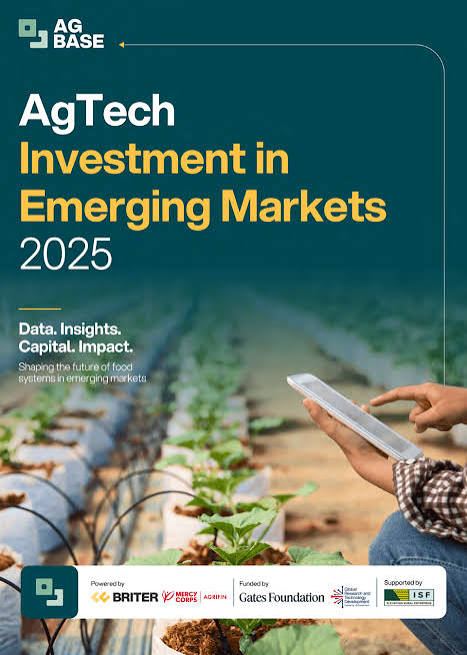
Briter’s new Agri-tech Investment in Emerging Markets 2025 report suggests that era is ending. It tracks $4.39bn in agtech funding across 17 emerging markets between 2023 and 2025, covering 700+ funded companies and 900+ capital providers. Read as a founder rather than an investor, the data amounts to a build list.
1. Know who your capital actually is
The report’s first finding is that capital is regional, not global. Southeast Asia and Latin America are led by venture and corporate investors. South Asia has a deep domestic base running from angels to private equity. Africa remains anchored by donors, accelerators, specialised agtech funds and DFIs.
Briter calls this a structural question, not a cyclical one. Waiting for a “VC recovery” to change your fundraising picture is the wrong bet. If you’re building in Africa, plan around the capital that exists: develop the reporting, impact evidence and commercial discipline that DFIs and specialised funds can underwrite, and don’t pitch like a Southeast Asian startup chasing corporate-backed venture rounds.
2. Build with the exit in mind
The report names exit pathways as the tightest constraint on scale. South Asia is the only region with repeatable, multi-modal exits. Latin America and Southeast Asia rely on strategic corporate acquisitions. Africa’s liquidity is almost entirely startup-to-startup consolidation, which generates scale but little capital recycling.
My read of what that means for founders (this is inference, not a finding from the page): you will probably be acquired by, or acquire, another startup. So build a business a peer can absorb: clean books, documented field operations, portable data, and distribution that plugs into someone else’s stack. And know that consolidation doesn’t return cash to the ecosystem the way a corporate acquisition or IPO would, so don’t promise your investors a liquidity event the market can’t yet deliver.
3. Agri-tech Founders need to Stop building purely digital
Briter’s verdict is blunt: pure digital models have been largely debunked. Trust and quality in agriculture require physical presence. The leading agtechs run field agent networks, own or partner in logistics, and manage fulfilment centres. “Phygital,” the report says, is now the baseline, not a workaround.
For founders, an app that sits above the farm gate and hopes trust, quality control and delivery sort themselves out is the wrong product. The defensible layer is the operational one: the agents who verify, the trucks that move, the warehouse that grades. It’s less glamorous than software, but it’s where the report says the leaders are.
4. Pitch margins, not users
The report says unit economics have replaced user metrics. Since 2023, investors have written smaller, more targeted cheques to startups with credible paths to profitability. User counts no longer move capital. Contribution margins, retention and downstream monetisation do.
Before your next raise, know your contribution margin per transaction or per farmer, your retention over full seasons, and what you earn beyond the first sale. If your deck leads with registered users, it’s leading with the metric investors have stopped rewarding.
5. Put impact inside the unit economics
Impact and commercial viability are converging. According to Briter, the models attracting the broadest investor base embed positive outcomes (lower costs, higher yields, access to higher-value markets) directly into how they make money.
That is a design principle. If your farmer outcomes are a separate “impact report” bolted onto the business, you’ll struggle to hold both commercial and donor-type capital. If the farmer’s higher yield or better price is the reason your revenue exists, the same business can speak to both audiences.
6. Locate yourself on the Investable Frontier
The report introduces the Investable Frontier, a framework that maps markets from pre-commercial ecosystems to mature commercial arenas and matches capital types, business models and return expectations to each. The practical use is diagnostic. Ask where your market and your business sit, and which capital fits that position. Pitching commercial equity to investors who want mature-market returns, in a market that is still pre-commercial, wastes a year. Matching a catalytic grant to a business that’s ready to scale wastes the grant.
The build list
– Operations over interface: field agents, logistics or logistics partnerships, and fulfilment capacity.
– Contribution margin, tracked per unit:** the number investors now ask for first.
– Retention across seasons: proof that farmers and buyers come back.
– Impact built into revenue: outcomes that explain how you earn, not a separate report.
– An acquirable business: clean, documented, and compatible with likely consolidators.
– Capital matched to stage: an honest read of where your market sits on the frontier.
The report’s central message is that agtech in emerging markets is being repriced around evidence. For African founders, that favours the less glamorous, infrastructure-heavy builders who were doing the hard work all along.
Source
Briter, “Agtech Investment in Emerging Markets 2025” (September 18, 2026).