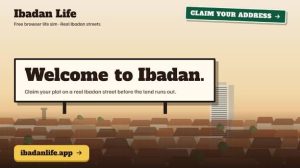
Just a little over a week ago #lagoslife hit the Internet and went viral. The light bulb flashed on in David Oladeji’s head. He started building on 4 October, three days after the Lagos Life launch post. #IbadanLife opened to players the next day.
What makes it more than a copy is its map. Ibadan Life doesn’t put you in a generic neighbourhood. You claim a plot on a real street, drawn from OpenStreetMap, with 489 streets across 45 areas. The Iwo Road flyover stands where it stands in life, and Cocoa House rents out storeys and suites. “Swap the city name and you have nothing,” the founder told us, “because the city is the data.”He is also blunt about what AI has changed.
In this conversation We ask him about all of it: why he built #IbadanLife, what he learned from watching Lagos Life’s economy break, how a land-buying game sits in a country where land tenure is contested, and his reaction to #IbadanLife being a copycat game . Here is the full conversation.

Why did you build the first city game on Ibadan rather than Lagos or Abuja, and what does Ibadan offer that a Lagos-centric game wouldn’t?
I was born in Ibadan even though my parents lived in Osogbo, Up until Uni I schooled in Ibadan, Uni, I schooled in Osogbo, while my parents lived in Ibadan and had to come home to this brown roofed city, my parents retired to Osogbo and I am back in Ibadan. Ibadan has played a big part in my upbringing, its familiar and yet still strange, its the only city in which I explored enough to get lost. All through uni I worked in a GIS company based in Kenneth Dike and my undergrad project in 2011 was about epidemics and managing them, most of that work was done on Ibadan.
Ibadan seats at the centre of whats familiar and what was just right in size and coverage, its a city that deserves more credit than it gets sometimes, the largest city in West Africa by area, and it has always been a city people from everywhere settle in. That mix is the foundation of the place, so in the game a character can have any roots, any faith and any dress, and none of it changes the odds.
Ibadan also has its own material that any other place cannot lend: Cocoa House, Mapo Hall, the University of Ibadan, Iwo Road, the amala politics of Adedibu and the Adelabu legend, and the joke everybody knows, “Lagos salary, Ibadan rent”. Our rents are about half of Lagos. A Lagos game is about hustle and traffic. An Abuja game about prestige and classism if you like, An Ibadan game can be about land, neighbours, politics and pacesetting.
#IbadanLife arrived shortly after Lagos Life took off. When did you start building it, and how much of the idea predates that moment?
I started on 4 October 2026, three days after Lagos Life’s launch post, while #lagoslife was trending. The waitlist went live that same day, the 4th: claim a plot on a real Ibadan street. The game itself opened to players on the 5th.
The honest answer is that Ibadan Life as a game does not predate that moment. What predates it is everything underneath. I have built money systems in fintech, so the server-kept ledger, the fraud controls and the audit trail were things I already knew how to build. Ibadan Life is also not my first game. Earlier this year I built Lovistgame (lovistgame.online), a trivia game where Nigerians answer questions, battle each other and earn coins they can redeem.
In the same period I built an app for investing in a person. Both taught me the less visible half of a game: coin economies, payouts and fraud. Through Uphiva, a community I manage, (uphiva.com) I had been thinking for a long time about how African businesses reach customers across cities without physically moving from one to the next. Lagos Life showed me the format that could carry that idea. I do not play soccer as a game, and a lot of my friends find that weird, however, games like SIMs, GTA, Rising lands, I have played some as far back as 2005 and as recent as days before the Lagos Life launch post, by the way I didn’t see the post that day it went up a friend kept posting his position on the Lagos Forbes leader and was talking about how the system was easy to hack. That specifically combined with all I have said sparked an idea, a challenge and an opportunity.
Lagos Life has said it was inspired by The Sims and Lagos Run. Where do you see #IbadanLife in that lineage, and what did you take from playing Lagos Life?
We are plainly in that line: Lagos Run, then Lagos Life, then us. I say so openly, and I wrote to Lagos Life’s creator proposing we work together rather than beside each other.
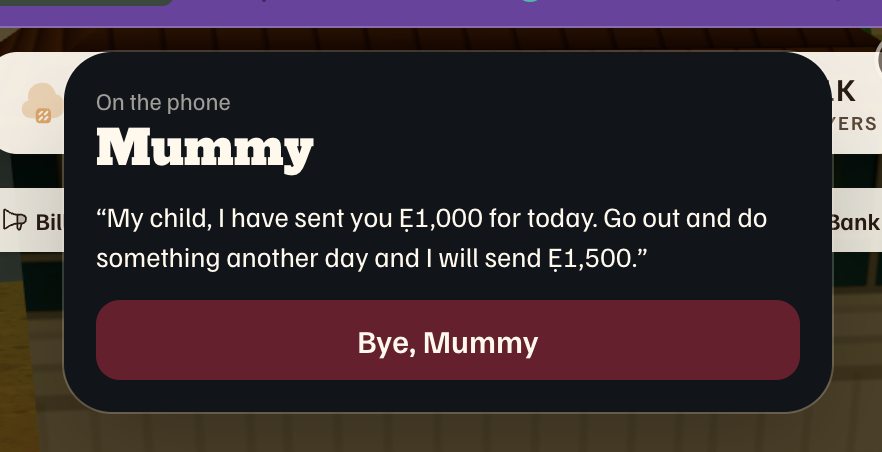
From Lagos Life I took three lessons. First, the in-game phone is the feature players love most, so ours is the centre of the game. Second, shipping fast is marketing: she shipped almost every minute because she kept asking players what to add, so we have a “suggest a feature” box and a public changelog (we eventually put this behind authentication but it was public for a long while). Third, and most important, I watched its economy break. Players were holding billions and giving them away, and the currency became a joke. So in Ibadan Life money only moves through a ledger on the server. A browser cannot mint it, every payment is a permanent row, and stolen money can be reversed, including what it was passed on to.
Where I think we go further than The Sims lineage: the direction is closer to a mix of GTA’s street freedom, Age of Empires’ building and trade, and Age of Mythology’s festivals and legends, set in African cities.
Is this just Lagos Life with a different city? Can you point to one feature or design choice that couldn’t be copied by swapping the city name?
My honest answer: the format is borrowed, the game is not. We share no code with Lagos Life, and the engine was built from an empty repository.
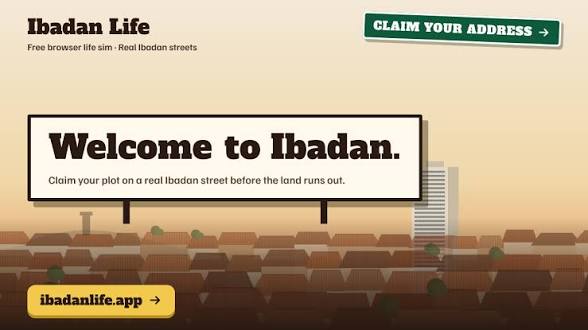
The one thing you cannot get by swapping a name is the address. In #IbadanLife you do not get a room in a generic neighbourhood. You claim a plot on a real street, in the area where that street really is, and you get a shareable link to it. The roads come from OpenStreetMap, the Iwo Road flyover stands on its piers where it stands in life, and Cocoa House rents out storeys and suites. Swap the city name and you have nothing, because the city is the data. Each new city needs its own map, its own areas drawn by someone who knows them, its own landmarks and its own voice. We know, because we are doing it for Osogbo now.
#IbadanLife uses real streets from OpenStreetMap and real landmarks, with 489 streets across 45 areas. How do you decide what counts as authentically Ibadan, and who checks it?
Three layers. The streets are not our opinion: they come from OpenStreetMap, with some place names and positions from the Overture Maps Foundation, and we credit both. The areas are a human job. OpenStreetMap does not name neighbourhoods the way Ibadan people do, so which street belongs to Molete and which to Oke-Ado is decided by a person, in an admin tool, and can be corrected. The landmarks are built from real photographs, never from memory.
Who checks it: the residents. The in-game phone has a Photos app where players send real pictures of real places, and we pay them in the game for the ones we keep. Players report what is wrong, and people who grew up there are quick to say when their street is in the wrong area. The street and area counts on our About page are live figures from the database, not marketing numbers. We are also honest about the gaps: OpenStreetMap leaves parts of the old core and the outskirts unnamed, and we fill those as people tell us.
You say openly that #IbadanLife is built with Claude. If a working multiplayer game can now be built in hours, what is the lasting advantage: the engine, the local detail, the community, or something else?
Not the engine. I am proof of that: the first version was live the day I started, and we have shipped close to two thousand changes in the eight days since. Anyone can do the same, so code is no longer the moat.
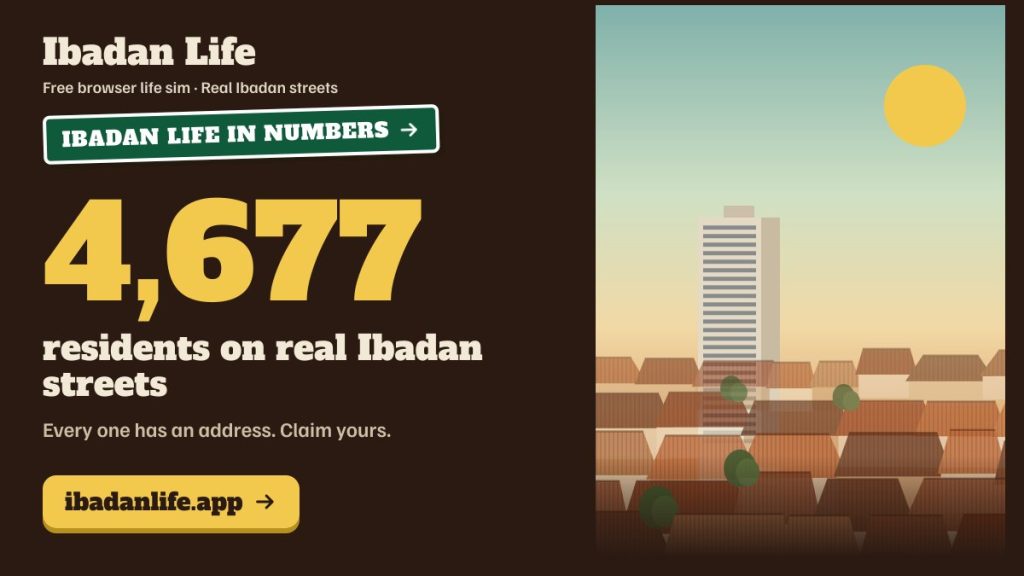
What lasts is, in order: the people, the local detail, and trust. #IbadanLife is worth visiting because your neighbours are there, and 5000+ residents on real streets is something you cannot generate. Local detail has to be earned street by street and corrected by people who live there. And trust is the quiet one: an economy that does not inflate into nonsense, a privacy notice that says in plain words what is recorded, and a game that still stands on a cheap Android phone. AI made the building fast. It did not make any of those three fast.
Players buy land, vote, and furnish homes, all of it fictional. Did you worry about how a land-buying game lands in a country where land tenure is real and contested?
Yes, and the answer is to be blunt about what it is. The first line of our privacy notice says the plots, rooms and addresses are not real property. The terms say land, houses and in-game money have no value outside the game, cannot be cashed out and cannot be sold for real money, and that nothing in the game is a real election, a real bank account or real advice. Trading accounts or land for real money is against the rules. The streets are real; everything that happens on them is made up, and we say so on the About page, the terms and a separate disclaimer.
We also keep real people out of it. Living politicians are not characters, hotels in the adult parts of the game have invented names, and tribe or faith never changes what a player can own or win. I think there is something useful in a game where an ordinary person can own land in Bodija and run for office, as long as nobody is ever confused about whether it is real.
How do you define success: active players, retention, or revenue? How central are billboard ads, and how do you keep them from breaking the immersion?
Retention first. A viral spike is easy to get in this format and means little. What we watch is the first ten minutes and whether people come back the next day, and we measure the game’s speed on players’ own phones because a slow game on a cheap Android is a player lost. Revenue matters because servers cost money, but it follows from people staying.
Billboards are the main commercial product, and they are the one kind of advertising that helps immersion instead of breaking it. A real city has billboards, wrapped cabs, shop signs and company names in the lobby of Cocoa House. So ours sit where they would sit in life, on the 3D map, rather than as pop-ups over the game. We keep the measurement honest too: an advert is counted once a day per person, the advertiser sees totals by day, hour and area, never a figure under five, and never who the person was.
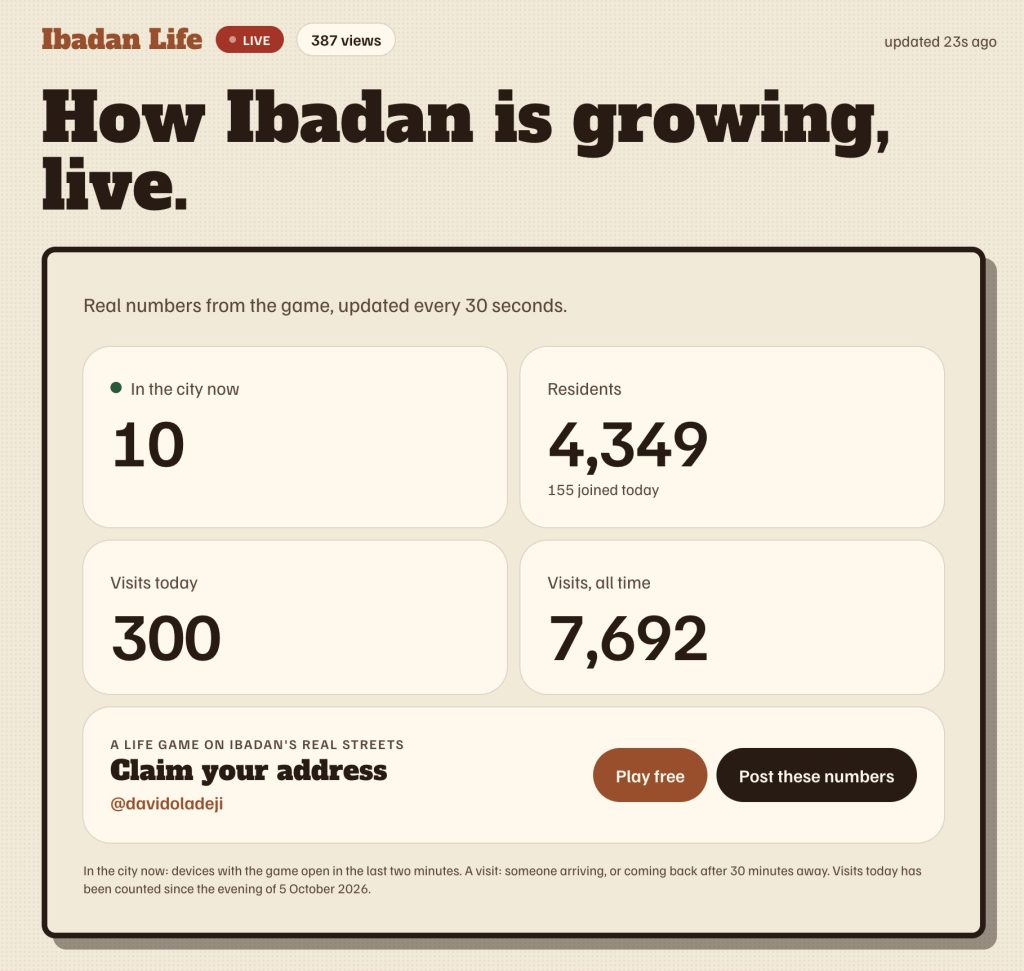
You say player names, emails, and chat messages are never sent to the AI. What other safeguards exist for player data and moderation as the city grows beyond 3,948 residents?
On data: the game is for adults, so we ask a date of birth once, and if someone is under 18 we keep only the day they turn 18. Emails are never shown publicly. Raw IP addresses and browser details are deleted after 90 days. Card details never reach us; a licensed payment company handles them. Where the game does use an AI model for a piece of writing, it is sent the character’s situation, not the player’s email, password or payment details. The privacy notice lists everything that is recorded during play in plain words, including where it is kept (a database in London), and players can delete their own account from the in-game phone without writing to anyone. The game is run by Uphiva Ltd under the Nigeria Data Protection Act.
On moderation: area chat is public to that area, private messages are seen by staff only when one of the two people reports them, players can block and report, and enough reports take a voice recording down without waiting for us. We can mute, suspend or remove accounts, and real-world tribal, religious or political abuse is against the terms. Behind that is the fraud layer: one account per person, rate limits, a blocklist, and an admin audit log that is chained so that staff actions cannot be quietly edited afterwards. Players who report an exploit instead of using it are rewarded in the game.
Anyone can build the same template for another city. What happens when twenty clones of every city game exist, and do you see #IbadanLife and Lagos Life as competitors or as one emerging Nigerian city-game scene?
One scene. Lagos Life proved the format and I have said so to its creator directly, with a proposal for players to travel between our cities. Our own Sim Passport already lets a character travel to other city games that accept it, carrying only their name and their look, while each city keeps its own residents and its own economy.
I also registered arena54.com (January 2025) for exactly this. The 54 is for Africa’s 54 countries. The site is now live as a map of the games being made across the continent, with the studios, developers, artists and composers behind them. Lagos Run, Village People and Vision27 are already listed. It also holds our API documentation, at developers.arena54.com. One key lets a store, a newsletter or another developer read the games, creators, events and rankings from a single API. Sign-in, shared leaderboards and letting listed games work with each other are planned next.
The clones will come. Twenty games of the same city cannot all have your neighbours in them. The ones that survive will be the ones with real people, a currency that holds, and detail that locals recognise. I would rather make cloning unnecessary: our engine now opens a new city from a map and a list of areas, Osogbo is next, and more Nigerian cities will follow. If someone wants to build their own city and connect it, that is a bigger scene for all of us, not a smaller share.