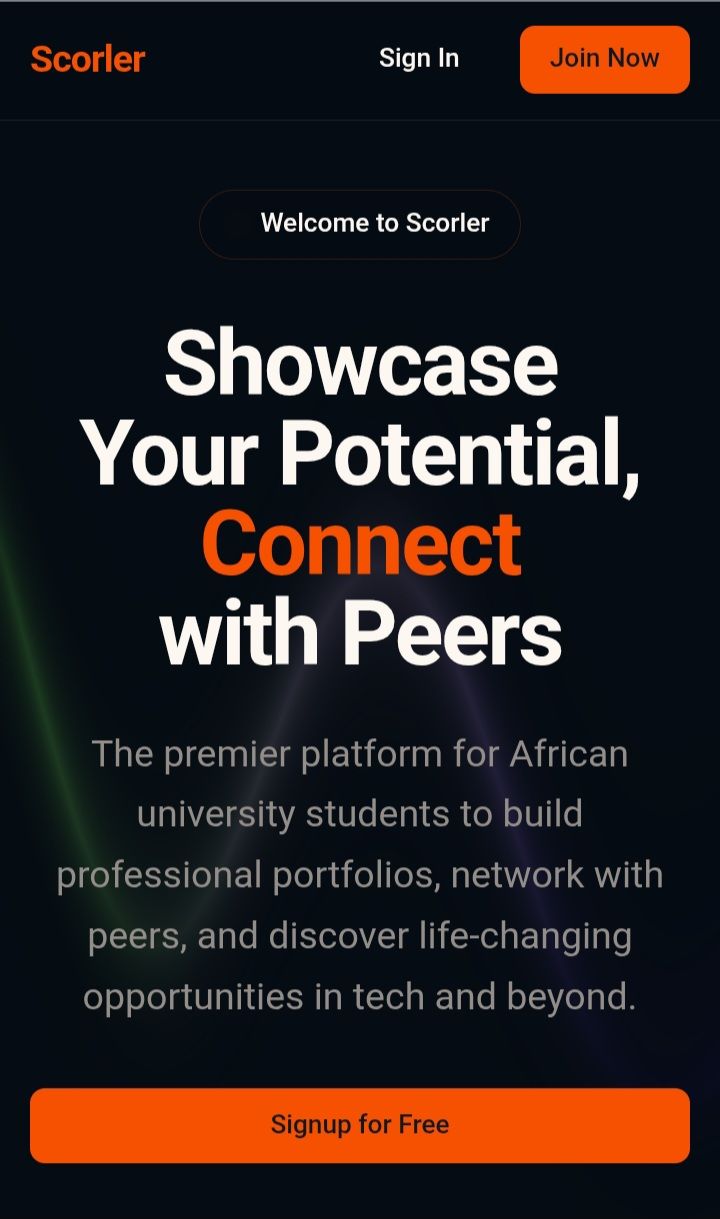
Scorler, a student portfolio and networking platform from Neo-Tech, launched on June 15, 2026, and describes itself as a place where African university students can “connect, showcase skills, and discover opportunities.” CEO Doonen Daniel Anyorikyo puts the founding idea more simply: learn and gain at the same time.
Since launching, the student portfolio platform has passed 100 users across five countries without spending a naira on paid advertising.
At that size the number is modest, and nobody should pretend otherwise. But how students found it matters: they came because someone told them about it, not because an ad followed them around. In a market where attention is expensive and trust is scarcer, that is worth noting.
The problem Scorler is Solving
Ask any African graduate how they prove what they can do. For most, the answer is a certificate and a CV that looks like everyone else’s. A degree says where you studied. It rarely says what you can build, and the skills students develop through projects, side work and late nights have nowhere credible to live. It runs as a mobile-friendly web app, which suits how most students actually get online: on a phone, often on a budget.
Scorler’s pitch is not overly complicated. Instead of treating years on campus as a waiting room before a career begins, Scorler treats them as the period when a track record can start. Build something, show it, get seen. The learning and the gaining happen side by side, not one after the other.
Why Scorler deserves a #BuiltforAfrica Feature
Scorler is worth watching for the following reasons
Organic pull.
Five countries and 100+ users with no ad budget suggests Scorler has identified a real the problem that cuts across borders, and we are interested in how it intends to adapt to deal with it
Student-first focus.
It’s built for African university students rather than adapted from a product designed for somewhere else.
A clear problem to solve
It helps a student turn effort into evidence, and gives peers, employers and institutions a place to find it.
The Techiesnode Verdict
As promising as we believe Scorler can be (traction in 5 countries without a marketing budget is a sign of an in-demand solution), the platform is four months old. It hasn’t yet shown the full picture of how work gets verified, which employers or institutions are on board, or what success looks when 100 signups multiply by 10 or by 100
Our ultimate analysis of Scorler will be based on how it tackles these three issues
1. Verification
A portfolio is self-reported by default, and self-reported claims carry little weight with a skeptical hiring manager. In markets where inflated CVs are a real concern, trust is the product. Platforms can earn it through lecturer endorsements, employer-confirmed projects, or assessments tied to real work. Without one of these, a profile is a nicer-looking CV.
2. . The demand side.
Student-side growth is the easy half of any ed-tech platform, because there is never a shortage of people who want to learn stuff or people who want to show off what they know, also students will join almost anything free that promises opportunity.
The harder question is whether employers, universities and programmes show up to act on what they find. Marketplaces in emerging economies often stall here: supply arrives through word of mouth, while demand needs sales, relationships and proof of hiring outcomes. Scorler’s organic spread suggests student pull. The “gain” in its founding idea depends on building the other side.
4. . Economics under constraint.
Students rarely pay, and institutional budgets are thin and slow. A platform serving them needs a revenue source that doesn’t tax its users, such as employer fees, institutional licences or sponsored programmes, while keeping costs low enough to survive at modest scale. Mobile-first design helps, since phones are the main computer for most students. But data costs and uneven connectivity still shape what users upload and how often they return.
Get involved
If you’re a student with work worth showing, start building your profile. If you’re an employer, lecturer or programme lead who wants to meet emerging talent early, take a look at who’s already there, start your Scorler journey here and see what Scorler is building.