SmallByte is not a VC-backed startup. It does not have a growth team or a pitch deck. But what it has quietly assembled in Lagelu, Ibadan, is more instructive than most funded ventures care to admit.
Walk into most Nigerian markets and the corner provisions store is a fixture, stacked floor to ceiling with noodles, soft drinks, baby products, and household staples. The owner knows regulars by name. The price negotiation is half the transaction. It is an institution the tech ecosystem has long wanted to disrupt but has rarely managed to dislodge.
SmallByte Multiventures, operating out of the Lagelu Local Government Area of Ibadan, Oyo State, is doing something different. Rather than waiting to be disrupted, it is doing the disrupting itself, quietly building a multi-product digital infrastructure around what is, at its core, a neighbourhood provision and drinks business.
The headline business is straightforward: wholesale and retail supply of beverages, household provisions, and everyday essentials to the Lagelu community. Soft drinks, energy drinks, juices, noodles, toiletries, baby products, the kind of inventory that moves daily and relies on trust and proximity to sell. That piece of the business is physical, local, and deliberately so.
But SmallByte has layered two digital verticals on top of it.
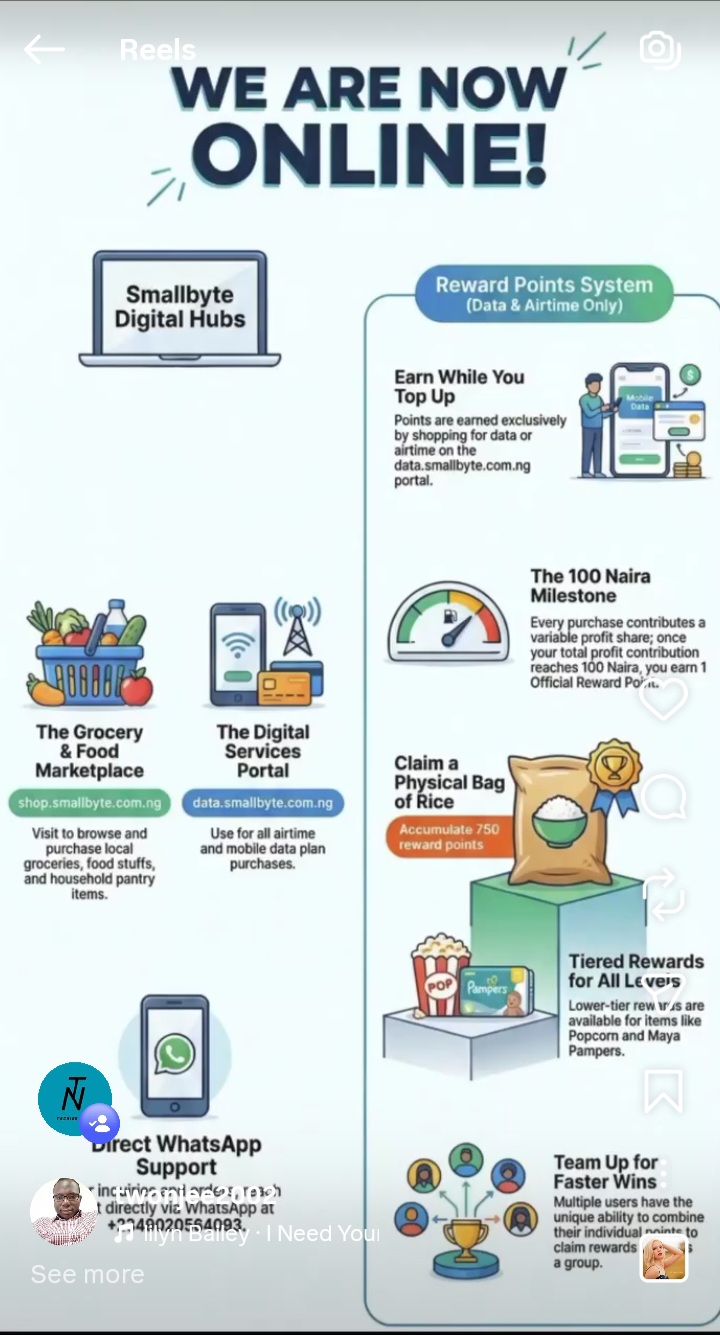
The first is BytesMart, an online grocery and provisions shop that extends the physical store’s reach to customers who prefer to order digitally. In a city like Ibadan, Nigeria’s third-largest, perpetually underserved by the e-commerce platforms built with Lagos in mind, that is not a small thing. BytesMart does not pretend to be Jumia. It does not need to be. It is solving a neighbourhood-scale problem: how do regular customers order from a store they already trust, without showing up in person?
The second is DataByte, a mobile data and airtime top-up platform supporting MTN, Airtel, Glo, and 9mobile. In a country where data reselling has become one of the most accessible micro-entrepreneurship plays, particularly since MTN’s SME data API opened up, DataByte represents a diversification move with real logic behind it. Foot traffic to a provision store and demand for affordable data often come from the same household. Owning both touchpoints is intentional.
What SmallByte describes as a “one-stop shop” is, in product terms, a bundled local commerce stack: physical retail, digital grocery ordering, and telecom top-up, wrapped under a single brand identity with its own domain architecture. Each sub-product has a clean subdomain, its own positioning, and what appears to be a mobile-first build. The main site handles brand and discovery; the sub-products handle conversion.
This architecture is not accidental. It is what happens when a small business owner thinks in systems rather than transactions.
The business also leans into communication channels its customers already use. WhatsApp ordering is prominently featured alongside the online shop, a sensible concession to the reality that many Nigerian consumers at the community level still transact conversationally, not through formal checkout flows. The friction of a shopping cart is real; a WhatsApp message to a number you have saved is not.
For the startup ecosystem watching from Lagos or Abuja, SmallByte is a useful data point. The conversation about digitising Nigeria’s informal economy has often centred on whether large platforms can acquire the trust of small traders and their customers.
SmallByte suggests a different path: that the traders themselves, given accessible tooling, can build the digital layer on their own terms, at their own pace, in their own communities.
There is no Series A here. There is no valuation to report. What there is, in Lagelu, Ibadan, is a provisions business that understood its own distribution problem well enough to build three products to solve it, and had the clarity to brand them together. That is the kind of founder instinct that ecosystems should be studying.