The Osun State Elections of 2026 have come and gone, and the winner has been declared. However there needs to be a reckoning about #Osundecides2026 especially as we prepare for the January 2027 General Elections.
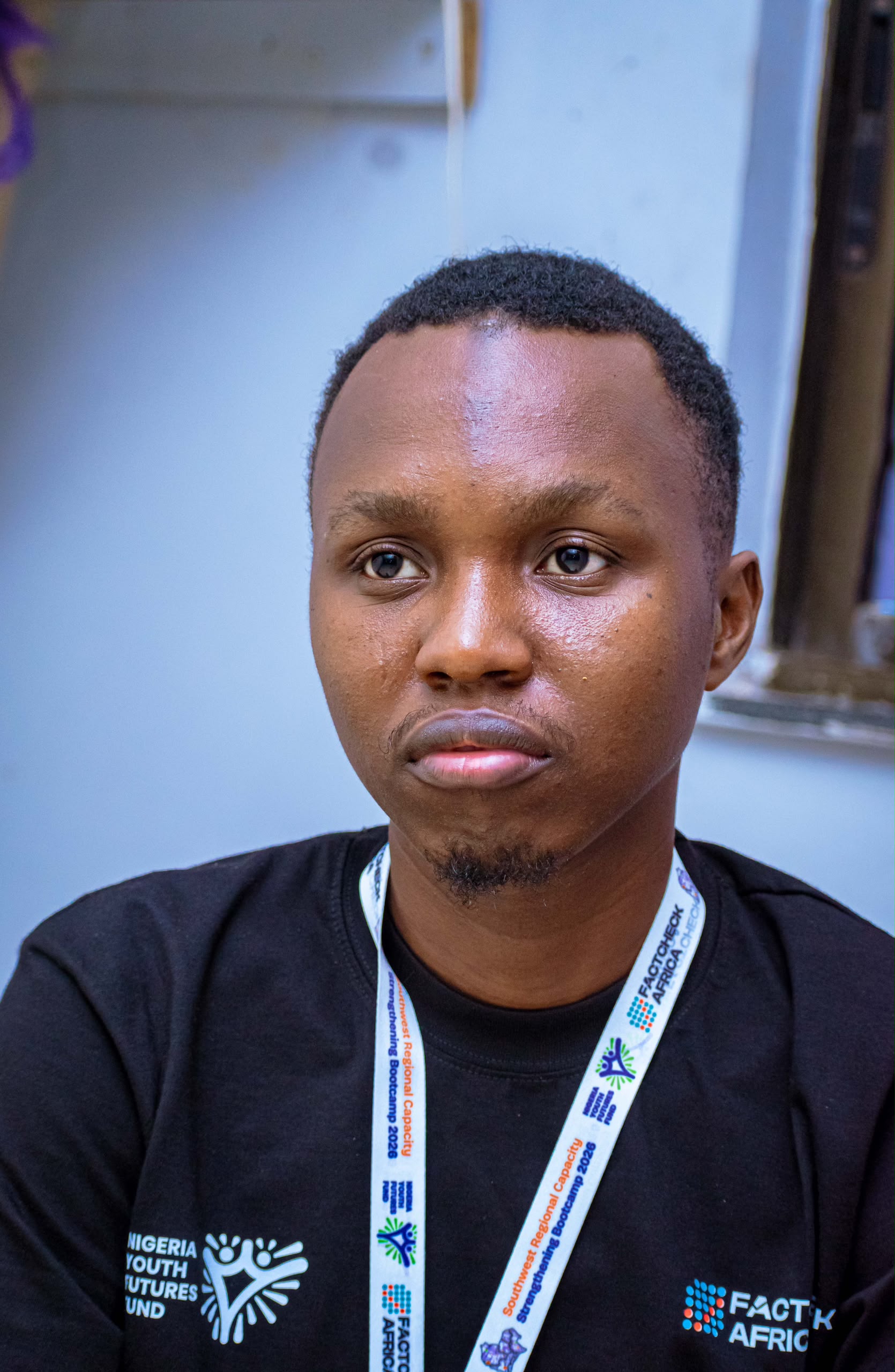
One topic that has come to dominate election conversations in Nigeria in recent years is the rise of AI, and the Internet, and how it contributes to disinformation and misinformation in the political space. On the blog today, we talk to Habeeb Adisa Editor and Programs Manager at FactCheckAfrica about the Osun 2026 Elections. He shares his insights on several issues what goes into building a strong election fact checking situation room, the common types of misinformation and disinformation that fact checking teams faced in course of the election, and what they expect going into the general elections in January 2027
How was the TruthGuard Situation Room was actually resourced? how many fact-checkers, what shifts, what tools/software stack, and what was the budget or funding source?
The TruthGuard Situation Room was resourced as a collaborative election-integrity operation rather than as a standalone under our team. It brought together FactCheckAfrica and our partner organisations, alongside the wider BallotEyes observation structure. On the field-observation side, we had 75 trained polling-unit observers covering the 30 LGAs, supported by 30 stationary LGA observers and three roving observers. Their reports fed into a hybrid Situation Room where information was received, assessed and verified in real time.
For information-integrity, our work involved monitoring election-related misinformation, disinformation, manipulated media, suspected AI-generated content and coordinated online attacks. We also had a public WhatsApp channel through which citizens could submit suspicious claims, photographs and videos for verification.
It was deliberately collaborative and the architecture connecting field observation, editorial verification, partner organisations, citizen reporting and real-time digital monitoring. That allowed us to move from a viral claim to verification much faster than a conventional post-election fact-checking workflow.
How did FactCheck Africa coordinate with the other groups running parallel operations Was there real-time information-sharing or duplicated effort?
Hmmm. I would describe it more as coordination than competition. Osun had several organisations monitoring the election from different angles, and we recognised that there was little value in trying to reproduce everything another organisation was already doing. The TruthGuard operation brought together FactCheckAfrica with the BallotEyes Working Group and other partners, including BBYDI, Oroki Hub, Legis360 and DNN Media.
For FactCheckAfrica, our particular value was the editorial and information-integrity layer. We were looking at what was circulating publicly, viral claims, images, videos, alleged endorsements, unofficial results and other election-related narratives and determining what could actually be established from the available evidence. At the same time, field reports could provide context for claims emerging online. So, the relationship was complementary: the field operation could tell us what was happening on the ground, while the editorial and verification process could test what people were claiming about those events online. In a fast-moving election environment, several organisations may encounter the same viral claim or incident independently. But I don’t think duplication is necessarily a failure in fact-checking. Sometimes independent verification is useful, particularly for consequential claims. What matters is whether organisations are adding evidence and clarity rather than simply reproducing each other’s work.
The Situation Room helped reduce that problem by creating a shared operational environment. We could receive information from observers and citizen submissions, identify what required urgent verification, and then decide what warranted editorial attention. We also had a public WhatsApp channel through which people could submit suspicious claims, photographs and videos for verification.
What were the two or three claims from Osun that were hardest to verify, and why deepfakes, recycled old footage, or claims that were technically true but misleadingly framed?
The hardest claims were not necessarily the ones that looked the most obviously fake. In fact, some of the most difficult were claims where there was a genuine piece of information or genuine media, but it had been repackaged to create a false impression. One good example was the claim that APC chieftain Akin Ogunbiyi had endorsed Governor Ademola Adeleke. The photograph circulating with the claim was real, so at first glance it will seem credible. The difficulty was establishing its context. We conducted a reverse-image search and traced the photograph to the 2022 Osun governorship election. His campaign team also publicly rejected the claim and reaffirmed his support for the APC candidate. So, the problem wasn’t that the image itself was fabricated; it was that old material was being presented as evidence of a new political development.
Another that I would call technically true but misleading framed claims. The Accord Party endorsement claim is a good example. There really was a declaration supporting the APC candidate, but it came from a faction led by Christopher Imumolen. The circulating claim presented that factional position as though it represented the official position of the entire Accord Party. We therefore rated it MISLEADING. Establishing the truth required more than finding the original statement; we had to establish who had the authority to speak for the party and compare that with official records.
The third was the Modakeke video. This was particularly instructive because the footage itself was genuine. We used digital keyframe analysis to establish that it was recorded during the election, and the Police Command confirmed that tear gas had been deployed during a commotion. But the accompanying claim also said that a ballot box had been snatched, and we could not independently verify that part. We therefore rated it PARTLY TRUE rather than allowing the authentic video to lend credibility to an unsupported allegation.
Did you encounter AI-generated content specifically synthetic images, cloned voices, AI-written statements attributed to candidates? How prepared were your tools to catch that versus a manual verification process?
AI-generated content was explicitly part of the threat environment we were monitoring. The TruthGuard Situation Room was tasked with monitoring election-related misinformation, disinformation, manipulated media, suspected AI-generated content and coordinated online attacks. We also invited citizens to submit suspicious content, including suspected deepfakes, through the Situation Room’s WhatsApp channel.
However, I would make an important distinction: we did not treat every suspicious piece of content as an AI-generated piece of content. In the cases documented by the Situation Room, some of our most difficult verification challenges were actually manipulated context and authentic media carrying unsupported claims.
Our approach was therefore still heavily evidence-led and manual. We relied on techniques such as reverse-image searching, digital keyframe analysis, comparison with original or earlier material, checking official records, and contacting authoritative sources where necessary. For example, in the Akin Ogunbiyi case, reverse-image searching showed that the photograph being circulated was actually from the 2022 Osun election. In the Modakeke case, digital keyframe analysis helped establish that the video itself was authentic and from the current election, while direct confirmation from the Police Command helped establish that tear gas had been deployed.”
So I would describe our tools as complementary rather than having a single AI-detection system that could simply tell us whether something was fake. The technology helped us investigate provenance and media characteristics, but editorial verification still depended heavily on human judgment, corroboration and source checking.
Do you have any way of measuring whether a debunked claim’s spread was actually slowed after your fact-check published, or does the correction typically arrive too late to matter?
I would not claim categorically that we have a sufficiently rigorous platform-level system to say that a particular fact-check reduced the overall reach of a false claim by a specific percentage. But we did have several ways of assessing whether our corrections were reaching audiences and entering the information environment.
First, our social media team tracked engagement with the fact-checks, and we saw good engagement on some of the Osun checks. We also deliberately did not treat the long-form article as the only product. We converted several fact-checks into short, accessible graphics that could circulate independently across our social platforms. That was important during the election because people were often encountering the claim first through a WhatsApp message, a social-media post, an image or a short video—not through a full article.
Second, we had a distribution network beyond FactCheckAfrica’s own platforms. Before the election, we had trained over 70 Osun-based journalists, and we maintained a group with them. When important fact-checks were published, we share the material through that network, and journalists could distribute it through their own platforms and professional networks. So, our strategy was not simply ‘publish and hope people find it.’ We were deliberately trying to put verified information back into the same networks where misleading information was circulating.
The Situation Room itself also gave us an important advantage because verification and distribution were happening during the event rather than weeks afterwards. For example, when claims about unofficial election results or alleged endorsements were circulating, the value of the correction was partly in getting credible information into circulation while the claim was still relevant.
Realistically, who is your fact-check reaching, is it changing minds among voters, or mostly being read by journalists, INEC, and civil society who already agree with you?
My honest answer is that our audience was broader than journalists, INEC and civil-society organisations, although those groups were certainly important audiences. For the Osun election, FactCheckAfrica was one of the media organisations accredited by INEC, so we were operating not simply as an organisation commenting from outside the electoral process, but as an accredited media actor reporting and verifying information around the election.
Also, our audience had been built before election day. FactCheckAfrica has conducted trainings and capacity-building activities across different states, including in Osun, and we have relationships with journalists, civic actors, youth organisations and other partners across different sectors and states. That gave us a distribution network that extended beyond our own social-media accounts.
Our social-media engagement during the election also showed us that ordinary users were interacting with the work. Some of the checks generated engagement, which tells us that the content was reaching beyond institutional audiences.
And its important for me to make a distinction, the objective of an election fact-check is not necessarily to persuade someone to support a particular candidate. It is to give people enough verified information to make their own decisions without being misled by fabricated or manipulated information. Our job is to improve the information environment in which that decision is made.
There is also a difference between the immediate reader and the ultimate beneficiary. A journalist may read our fact-check and use it in a broadcast. A civil-society organisation may redistribute it. A voter may encounter the same correction later as a graphic on social media or through a journalist’s platform. So, measuring only visits to our website would significantly underestimate the reach of the work. The network we have built through trainings and partnerships across states is therefore important. We are not trying to build a closed audience of people who already agree with fact-checking organisations. We are trying to build trusted pathways through which verified information can travel into communities and media environments where misinformation is actually circulating.
What was the single biggest operational gap this cycle — funding, staffing, access to platforms (e.g., Meta/X data access), or something else?
During an election, the information environment changes extremely quickly. Within the same few hours, we were dealing with reports from the field alongside old photographs being recirculated, unofficial results, alleged endorsements, manipulated videos, and claims that required direct confirmation from institutions. The real operational challenge was therefore not simply finding information; it was having enough editorial capacity and resources to assess, prioritize, verify and distribute the most consequential claims quickly.
The TruthGuard structure helped us manage that by bringing the field-observation and information-verification functions into a collaborative Situation Room. The wider operation had 75 polling-unit observers across all 30 LGAs, supported by 30 stationary LGA observers and three roving observers, while reports were being received and verified in real time. That gave the editorial operation access to a much broader stream of information than a conventional newsroom would normally have, but it also meant that the volume of material requiring assessment increased considerably.”
There was also a funding constraint. The Situation Room was built substantially around collaboration between the participating organizations rather than around a dedicated grant or project-specific funding. The participating organizations contributed resources from their existing operational capacity, which allowed us to get the operation running, but it also meant that we had to be very deliberate about what we could realistically deploy and sustain.
Is this situation-room model reusable for smaller, non-marquee state elections that don’t attract this level of coalition attention, or does it only work because Osun was high-profile?
Yes, the model is reusable, but the scale should be adapted to the election rather than assuming that every election needs an Osun-sized operation. Osun gave us the opportunity to build a relatively broad coalition because it was a high-profile governorship election. In fact, our experience with Osun reinforced for me why partnerships matter. Factcheck Africa didn’t have to build every capability from scratch. The Situation Room brought together different organisations and networks, while our existing relationships with journalists and civic actors, including people we had trained in Osun and other states, gave us additional channels for distributing verified information.
What would you build differently for the next election if resources weren’t a constraint?
We would build a much stronger data and monitoring layer. We could monitor public conversations, but we did not have comprehensive visibility into how narratives were moving across every platform, particularly closed or difficult-to-monitor environments such as WhatsApp. With more resources, we would want a system that maps emerging narratives, identifies spikes, tracks how a claim moves between platforms, and helps the editorial team prioritise what requires immediate verification.
We would expand the local journalist and civic-observer network. One of the things that worked particularly well in Osun was that we were not relying only on our own newsroom. We had trained journalists in the state and partners across different sectors and states who could help distribute verified information. With more resources, we would turn that into a more systematic network: train local journalists before elections, establish clear reporting protocols, provide verification support, and create a trusted distribution network that remains active beyond election day.
We would invest heavily in distribution. We learned that producing an accurate fact-check is only half the job. We already produced short graphic versions of checks for social platforms and used our journalist network to push them further. With more resources, we would develop platform-specific formats, local-language materials where appropriate, stronger WhatsApp distribution, and partnerships with radio and other local media so that corrections reach people who may never visit a fact-checking website.
What’s your honest read on whether Nigeria’s fact-checking ecosystem is getting ahead of AI-generated disinformation, or falling further behind it?
I say that from my own experience. More people send me claims directly and ask, ‘Is this true?’ That happens outside the formal fact-checking process. It tells me that people are beginning to recognise that they cannot automatically trust everything they encounter online and that there is value in having someone who can help them verify it. For me, that is one of the clearest signs that fact-checking is becoming part of everyday information consumption in Nigeria.
But AI has made the basic question of ‘What should I believe?’ much harder. We are moving beyond the old assumption that the way something looks is evidence of its authenticity. You can now encounter an image, video, audio recording or piece of text that looks and sounds convincing but may never have happened. The old idea that ‘seeing is believing’ is becoming much less reliable. Now, we have to ask: Where did this come from? Who produced it? When was it produced? What evidence corroborates it? And what exactly does the material prove?”
That is why I think fact-checking alone cannot solve the problem. Organisations like FactCheckAfrica and our partners are also investing in digital and media literacy, including work that reaches people beyond major cities and into grassroots communities. The goal is not simply to tell people, ‘Send everything to a fact-checker.’ It is to help people develop the habits and skills to pause, question, verify and recognise manipulation themselves.
We have seen encouraging results from that work. Through trainings and engagement with journalists, young people, civic actors and communities, we are seeing greater awareness of how information can be manipulated and more willingness to question suspicious content. The fact that people now sometimes come directly to me with a claim and ask me to help establish whether it is true is, in itself, a small but meaningful indicator that verification is becoming part of people’s information behaviour.
But there is still a huge amount to do. AI is lowering the cost and increasing the speed at which misleading content can be produced and personalised. Fact-checking organisations therefore need stronger media-forensics capabilities, better monitoring systems, more local-language and grassroots media-literacy work, stronger collaboration with platforms and researchers, and sustainable resources to keep up. So, I wouldn’t describe Nigeria’s ecosystem as losing. There is a lot of excellent work happening, and the fact-checking community has developed considerably. But I also wouldn’t say we are ahead of AI-generated disinformation. We are in a race in which the technology is evolving extremely quickly. The response has to evolve from simply debunking false claims after they appear to building a society in which people are more resilient to manipulation in the first place.