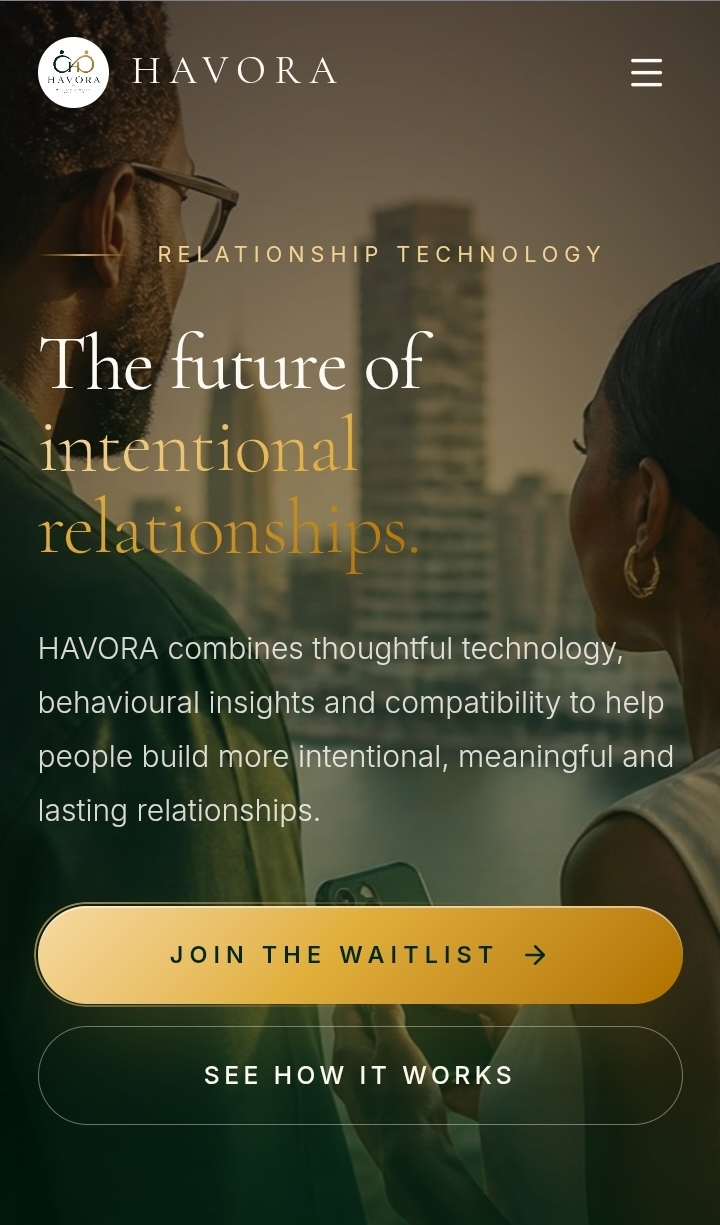
A new relationship-tech platform wants to replace the swipe deck with verification, compatibility research and curated introductions.
Nigeria’s dating app landscape is not short of options. From swipe-first platforms chasing volume to location-based apps built around proximity, the model has largely converged on the same loop: discover, swipe, match, chat, repeat. HAVORA, an early-stage relationship-technology company building an iOS-first platform, is positioning itself against that loop entirely — betting that the people most likely to build lasting relationships are underserved by apps optimised for engagement rather than outcomes.
The Problem HAVORA is Naming
HAVORA’s starting premise is simple: people are intentional about their careers and finances, but dating platforms rarely ask them to be intentional about who they connect with. Its pitch draws a direct line between “surface-level discovery”, the default mode of most dating apps, and the difficulty of finding a relationship that’s actually built to last. The company describes its target user as adults, in Nigeria and across the diaspora, who are serious about building something lasting rather than casually browsing.
How HAVORA Works
HAVORA’s product is structured around a four-step flow, moving a user from onboarding to an actual connection:
1. Understand You. A structured onboarding process that goes beyond a bio and a few photos, exploring values, life goals, personality, communication style and lifestyle before a user ever sees a potential match.
2. Verify & Build Trust. Government ID and video-selfie verification, designed to produce a trust score and a verified badge, aimed at making sure the people on the platform are who they say they are.
3. Understand Compatibility. Rather than a black-box score, HAVORA is building a compatibility framework across specific dimensions, values, lifestyle, future goals, communication style and relationship vision that it says is grounded in relationship and behavioural research rather than assumption.
4. Connect Intentionally. Instead of an endless feed, users get a small number of curated introductions, each accompanied by the reasoning behind the match, shared values, aligned goals, complementary communication styles, so a conversation starts with context instead of a cold open.
The company frames this whole approach with a line worth noting: HAVORA is meant to be “a garden, not a marketplace”, built for people who want relationships cultivated with intention rather than treated as a numbers game.
The Trust Layer as Differentiator
Where HAVORA is most clearly trying to separate itself from the pack is verification. Identity checks, government ID plus a video selfie, sit at the centre of its pitch, addressing a real and persistent problem in online dating across Africa: fake profiles and romance scams that erode trust in the category as a whole. Pairing verification with a compatibility framework, rather than treating them as separate features, is the core of HAVORA’s bet, that people looking for something serious will choose a smaller, more accountable pool over a larger, anonymous one.
Research Over Assumptions
HAVORA is explicit about grounding its compatibility framework in established relationship and behavioural research, combined with direct user research into how people in Nigeria and the diaspora actually navigate modern dating. It’s also careful, and this is worth flagging as a strength, not to overclaim: the company states plainly that it does not claim scientifically proven compatibility or predict relationship outcomes, and describes its framework as something being validated as it goes, with commitments to share what it learns honestly.
Where Things Stand
HAVORA is currently pre-launch, building its MVP for an iOS-first release starting in Nigeria, with plans to expand to more markets and platforms over time. The company says it intends to offer a free core experience, alongside an optional subscription tier, HAVORA Plus still being defined, that may offer deeper compatibility insights. A privacy policy is promised ahead of launch. For now, prospective users can join a waitlist to get early access as the product nears release.
Why It’s Worth Watching
The dating app category in Nigeria has largely competed on reach and ease of use. HAVORA is making a different argument, that the market has room for a platform built around depth over volume, with trust mechanics as a first-class feature rather than an afterthought. Whether that bet pays off will depend on execution once the product actually ships. But the thesis itself, that intentional daters are an underserved segment, and that verification and research-backed compatibility could be the wedge, is a coherent one, and worth tracking as HAVORA moves from waitlist to product.
Interested in being part of the HAVORA? Join the Waitlist here.