At the Ibadan Creator’s Summit last Saturday a group of selected creator attendees were asked to play a game in which they had to sell random items convincingly to the audience. A creator, self-styled Abdulbasit Omo Omo Dosunmu, decided to deliver his “sales pitch” in Yoruba, instead of the English that every other contestant used, to the thunderous applause from the impressed audience.
But it was not only the audience that was impressed, a number of special guests including Hon. Akinsete Olakunle, the Special Adviser to the Oyo State Governor on Housing and Urban Development, who offered him a campaign gig during the event, took notice of the young man’s talent.
The reception that Abdulbasit received for his display is not surprising. Ibadan, unlike metropolitan ecosystems like Lagos or Abuja is an almost homogenous Yoruba ethnicity and language state. Creators like Arojinle, Ayo Adams and Orolabi, are based in the city, yet they command national, if not global viewerships for their unique Yoruba content. Yet for all Yoruba’s dominance in the city, the language rarely if ever appears in its tech or creator ecosystem.
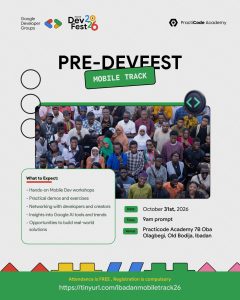
Walk into almost any tech meetup, demo day, or creator summit (Ibadan Tech Expo, Innovation Scale Forum, Google Devfest, even the aforementioned Ibadan Creator’s Summit) in the Ibadan ecosystem and you’ll find a familiar lineup: fintech, logistics, AI-for-productivity, maybe a healthtech panel if the organizers are feeling ambitious. What you almost never find is a panel, a demo, or even a passing mention of the technology work happening on Yoruba. At best a Yoruba Language creator might have a chance to perform, or maybe a brand selling a traditional/cultural product may have a chance to exhibit, but it rarely if ever, goes any further than that.
Even in ecosystems like Osun, Ondo, and Ekiti, ecosystems more homogeneous than Ibadan where Yoruba is the dominant spoken language on the street and the dominant creative language on people’s phones. That contradiction is worth sitting with, because it says something about how Nigerian tech events decide what counts as “tech” in the first place.
Yoruba Language Tech Research Exists, It’s Just Not In The Room
The gap isn’t a lack of work. We at techies Node have platformed a number of native language (or at least native language adjacent) platforms such as Yetunde , Ewe, and Awalingo. The issue is a lack of proximity between where the work happens and where the industry gathers.
AfricaNLP, now in its seventh year, convened in Rabat in March 2026 as part of the European Chapter of the Association for Computational Linguistics, under the theme of multilingual, multimodal language models. The workshop drew 56 submissions and accepted 30 as archival contributions, several with direct Yoruba relevance, including an evaluation of speech-recognition models trained on a Yoruba proverb dataset, and a multi-agent AI tutoring system built specifically around the Nigerian curriculum. A separate paper on systemic bias in multilingual tokenization, co-authored by researchers connected to the Masakhane network that has anchored much of the continent’s open NLP work, was accepted at the same venue.
None of that made it into any Nigerian tech conference agenda. It circulated in ACL proceedings, in a workshop hosted on another continent, reviewed by an international program committee. The researchers doing this work are frequently Nigerian, sometimes Yoruba-speaking themselves, but the venue where their findings surface is academic, not industry, and definitely not the creator-economy events where the language’s actual daily users are gathering by the thousands.
The Resource Problem is the Elephant in the Room
Even with that research output growing, Yoruba remains what the field calls a low-resource language, meaning there still isn’t enough clean, structured, machine-usable data to make most NLP tasks work reliably at scale. A systematic review covering a decade of Yoruba NLP research found that code-switching remains a persistent complication, and that despite deliberate initiatives to sustain the language, younger speakers increasingly default to mixing it with English. That’s a double bind for anyone building language technology: the data pipeline depends on speakers producing clean, structured Yoruba content, but the demographic producing the most content, young, online, creator-economy Yoruba speakers, is also the demographic most likely to code-switch, remix, and blend the language in ways that are creatively rich but technically messy to model.
This is precisely where content creators become more than an entertainment footnote. Every skit, voice-note explainer, or Yoruba-language TikTok series is, whether its creator realizes it or not, a data point in exactly the kind of low-resource-language gap researchers are trying to close. Right now, almost none of that value is being captured, credited, or even acknowledged in either direction, the researchers rarely engage the creators, and the creators are almost never invited into rooms where the researchers are presenting.
Proximity To A Language Isn’t Investment In Its Technology
The uncomfortable part of this state of affairs is that it isn’t explained by distance from Yoruba as a language. If Ibadan, arguably, one of the most linguistically homogeneous tech ecosystems in the country, still platforms almost nothing on Yoruba language tech. That’s a signal that the omission isn’t geographic, it’s structural. Local pitch nights and demo days are built around a startup narrative that rewards funding rounds, user-growth charts, and defensible market size. Language infrastructure work, (especially Yoruba as it is ) datasets, ASR models, tokenizers, cannot produce that kind of “data tested results” on the usual timeline, so it doesn’t get invited to compete for stage time against the next fintech raise, even in a city where the language itself is everywhere.
What The State Of Play in Yoruba Language Tech Actually Shows
Overall it is not that nothing can be done or that “nothing is happening.” However for any progress to happen, the three stakeholders, academic NLP researchers, Yoruba language content creators, and Nigerian tech-event organizers, must quit operating in almost complete isolation from each other, and each group become more aware of how directly their work depends on the other two. The research needs the creators’ data. The creators’ relevance to the AI conversation depends on researchers building tools that actually work in their language. And the events claiming to represent “Nigerian tech” keep leaving both groups out of their programmes. Until one of those three groups starts deliberately building the bridge, native-language tech will keep showing academic progress on paper while remaining functionally invisible everywhere Nigerian tech actually gathers to talk about itself.
For us at Techies Node, we think the Yoruba Language Tech is an assignment worth taking up, so among our goals would be to find these stakeholders and try and bring them together as much as we can. In the coming days weeks or months, we will platform various stakeholders who are putting the work in Native language tech. We don’t know how far the rabbit hole goes, but we have an idea of where to start from.