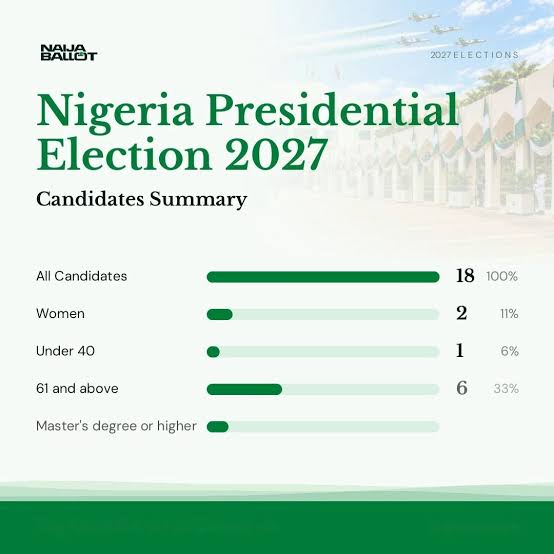
Every Nigerian that is old enough to vote can at least name the three frontline presidential candidates, but far fewer can remember any of the remaining fifteen of the eighteen people who have been cleared to run for president in January next year.
Unfortunately, the further down the pyramid it goes, the harder it is for people to identify political candidates. Hardly anyone except direct affiliates know who is running for their State House of Assembly seat, or even which ward and constituency they live in for that matter.
Naija Ballot, built by a team in Ibadan, is trying to close that gap with a search box and a ward map.
The Gap is Local
Nigeria’s elections are crowded at the bottom of the ballot. In the 2023 state elections, TheCable reported 640 candidates for the 40 seats in the Lagos State House of Assembly, and 981 candidates for the 27 seats in Imo’s. A voter who can name the presidential field has no easy way to learn who is on the list for the seat that shapes their ward.
The obstacle is not only awareness.
To research your own candidates, you first need to know your ward, your state constituency, your senatorial district and your federal constituency. Those boundaries rarely appear on a campaign poster, and most people do not carry them in their heads.
Naija Ballot starts from that gap. The platform describes itself as nonpartisan, and its pitch is that a voter should be able to type an address and see the electoral locations it falls in, then the people asking to represent them.
Naija Ballot: From address to candidates
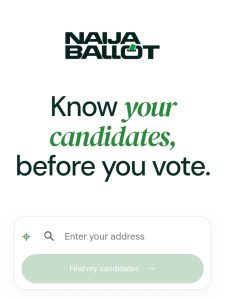
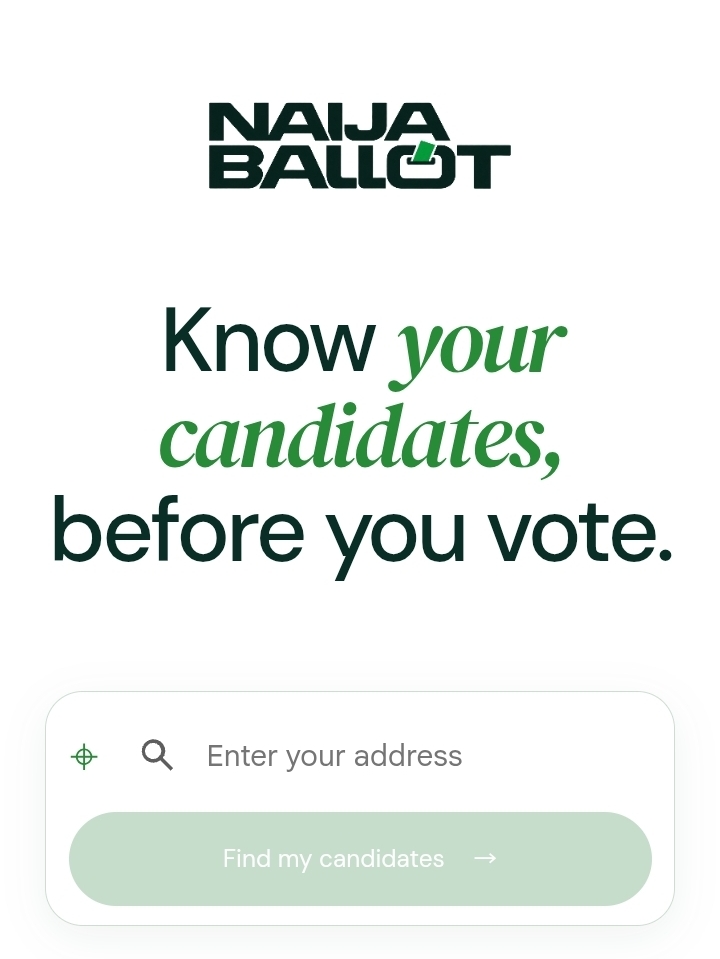
The flow on the Naija Ballot homepage is short. A user enters an address, the site shows the address it identified and asks “Is this your address?”, and a confirmed match leads to the candidates for that location.
Behind that one step sits the platform’s main technical claim: it combines address search, constituency information and ward mapping so a street address resolves to electoral locations. Those are the ward, the senatorial district and the federal constituency, plus the State House of Assembly constituency the platform is built around.
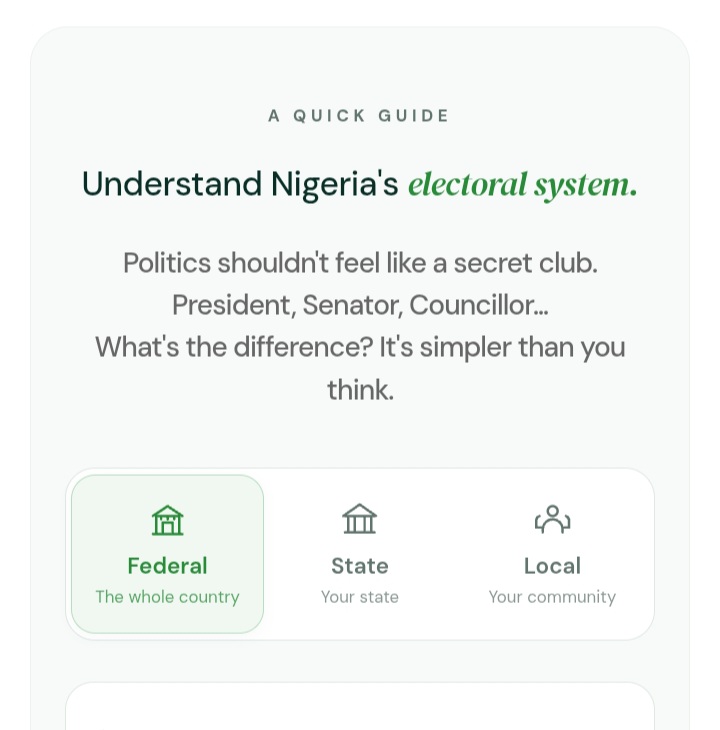
Beside the search box, the homepage carries a plain-language guide to the offices on the ballot. It sorts them into federal, state and local tiers and says which geography each one answers to: the whole country for the President, a senatorial district for a Senator, a federal constituency for a House of Representatives member. The site’s own description reaches down to ward councillor. That guide matters as much as the search box, because a voter cannot compare candidates for an office they cannot place.
The unglamorous infrastructure
The interface is the visible part. The harder work is turning scattered, inconsistent records into something a voter can search and compare.
Naija Ballot’s team has not named its data sources in the material published so far, but the official candidate lists show the problem. INEC has published State House of Assembly lists as PDFs, with columns for party, candidate, age, gender, disability status, qualifications and constituency. The 2023 lists also came in numbered amendments carrying remarks such as court orders (Amendment 06, Amendment 07).
The qualifications field is free text. In INEC’s 2019 final list, one candidate’s entry reads “FSLC, WAEC, BSc” and another’s “FSLC, WASC, OND”, with a third simply “HND”. WAEC and WASC are the same examination body written two ways, and some entries list every certificate while others list only the highest.
That is where the platform’s education classification model comes in. It groups differently written qualifications into consistent categories, so a voter can filter and sort candidates by education instead of reading raw strings. Age filters, sorting tools and generated summary charts sit on top of that cleaned layer. The charts are meant to show the shape of the candidate field, such as age spread and education mix, beyond individual names and party logos.
This is the infrastructure-first part of the story. Anyone can build a candidate page. Keeping the underlying records clean and comparable across many states is the work that decides whether the pages can be trusted.
Naija Ballot is not the first, to tackle this issue
Candidate lookup in Nigeria elections is not new ground. Open Cities Lab’s MyCandidate Nigeria already lets voters find the candidates in their constituency, and its state election view lists House of Assembly and governorship contenders. Other tools do a different job: the Naija Elections app answers questions about the Electoral Act, the constitution and INEC guidelines, which is rules rather than candidates.
That crowded field is useful context rather than a problem. A Guardian commentary argues that Nigeria’s civic-tech gap is fragmentation more than a shortage of apps.
The test for Naija Ballot is whether its specific choices, address-level lookup, a normalised education field and summary charts, make candidate research easier than the existing tools, and whether other tools and newsrooms can build on its data.
What will decide whether it lasts
A civic tool earns trust through its failure modes. Five questions will matter more than the launch announcement:
• Address accuracy.
Nigerian addresses are often informal and inconsistent. A wrong ward match sends a voter to the wrong candidates, so the platform needs to show how it handles low-confidence matches. The confirmation step on the homepage (“Is this your address?”) is a good sign, and it needs a fallback when the match is wrong.
• Data freshness.
Candidate lists change. INEC’s 2023 amendments, for instance, carried court-order remarks. Voters need to see when each record was last updated and where it came from.
• Classification transparency.
Grouping qualifications into categories is useful, but the category definitions should be public, and a tidy education label should not read as a ranking of who will govern well.
• Coverage.
The site describes offices from President down to ward councillor, while the platform’s pitch centres on State House of Assembly candidates. Users should be able to see which offices and states are fully loaded today.
• Sustainability.
Daniel Essang a journalist from the Guardian warns that many civic platforms depend on grants or short-term volunteers. The site calls Naija Ballot “a Nigeria Gateway project”, and readers will want to know who funds and maintains it between election cycles.
Built in Ibadan
Naija Ballot was co-founded by Dolapo Taiwo and Laolu Omokanwaiye and built by a team in Ibadan that combines product design, technology, data and communications. It is a useful counterweight to the idea that civic infrastructure comes only from Lagos or Abuja: the unglamorous work of cleaning records and mapping wards is happening in Ibadan.
The timing gives the platform a real test. Parties are already naming candidates for the next cycle; the Lagos APC chapter, for example, has announced 24 House of Representatives candidates and 40 State House of Assembly flagbearers. When lists like these are finalised, the question is whether Naija Ballot’s data keeps pace with them.
Naija Ballot’s stated aim is modest and sound: to give voters a starting point for research, to give journalists and civil society groups an accessible source, and to make lesser-known candidates easier to find. If it keeps its data honest and its methods visible, a Nigerian voter could walk into the next election knowing their ward, their constituency and the name of everyone asking for their vote. If it does not, it will join the long list of civic tools that launched well and went stale.