
Most Nigerian small businesses don’t run on accounting software. They run on notebooks, WhatsApp threads and memory. Kudilo’s belief is that the fix isn’t a better spreadsheet, it’s removing the data-entry step altogether.
The Problem Kudilo Solves
For BumBum Fashions* A growing fashion designer, a day at her shop typically involves a myriad of decisions in an informal economy buit on familiarity and trust. She sells three pieces on credit, takes a part-payment by transfer from a frequent customer, buys packaging, pays a dispatch rider. Her way of recording all these things is usually her memory or whatever notebook she happens to have at hand that moment.
That’s the unglamorous infrastructure gap under most of Africa’s small commerce: not a shortage of apps, but a shortage of records that people actually keep current. Kudilo is aimed squarely at it.
What Kudilo is
Kudilo, from Kudilo Technologies Limited, is an AI bookkeeper that works through chat. You describe what happened in plain language, and it structures the entry. The site’s own example: “Sold 3 wigs to Amaka for ₦45,000. She paid ₦20,000.” Kudilo logs a ₦45,000 sale, ₦20,000 received and ₦25,000 still owed, as one linked record rather than three loose figures.
Kudilo runs on iPhone, Android and in the browser, with one account covering two spaces: a Business space (sales, debts, invoices, receipts, profit) and a free Personal space (spending, income, money lent or borrowed).
What’s actually under the hood
• Debt tracking. Ask “Who owes me?” and open balances are ranked biggest first; repayments are recorded against the person.
• Invoices and receipts. Branded PDFs built from a one-line description; any paid sale can become a receipt.
• Business Page. A shareable storefront where shoppers build an order and send it from their own WhatsApp. Kudilo doesn’t collect the shopper’s name or phone number. Booking pages reserve a slot and can take a deposit through secure checkout.
• Inventory and staff. Stock on hand, cost and selling prices, low-stock reminders. Up to three staff get their own access, every entry shows who recorded it, and staff can only fix their own.
• Personal Bills. Airtime, data, electricity and TV payments from chat, with recipient, amount and fees shown for confirmation before money moves.
• Accountant handoff. Excel and CSV exports, plus standard PDF reports.
One design choice is worth noting: stock updates “never change the books on their own,” and corrections require you to confirm what will change. For a tool that records money, that restraint matters more than the AI label.
Pricing: flat, and refreshingly blunt
There is one paid plan, Kudilo Pro: two weeks free with no card needed, then ₦3,000 a month, ₦9,000 a quarter or ₦36,000 a year. Personal stays free. There are no per-staff, per-invoice or add-on charges.
Note the arithmetic: the quarterly and annual prices are exactly three and twelve times the monthly price. There is no discount for committing, which is unusual and arguably honest for a market where cash flow is tight and long commitments are a hard sell. Payment is by card through Paystack or bank transfer, billed in naira.
Built for Africa, or just built in Nigeria?
Kudilo’s local fit is real in places:
• Naira-first, with room to grow. Books can be kept in naira, dollars, pounds or Ghana cedis, and invoices offer the matching payment route: bank transfer for naira, Zelle or Cash App for dollars, sort-code transfer for pounds, and MTN MoMo, Telecel Cash or AirtelTigo Money for cedis. The company says more African currencies are coming.
• WhatsApp as the storefront rail. Orders go through the channel customers already use, instead of forcing them into a new checkout flow.
• Photo and screenshot capture. In a market where proof of payment is usually a bank-alert screenshot, reading that image is the right input.
• Data governance. Kudilo Technologies Limited states it is registered with the Nigeria Data Protection Commission as a Data Controller/Processor.
The infrastructure-first questions
This is where the hype comes off.
Language.
The FAQ says Kudilo works in English. Yet several of the testimonials on the homepage are written in Pidgin, and the product’s users think and sell in Pidgin, Yoruba, Igbo and Hausa. How well the system handles code-switched, informal input (“I sell am 12k, e never pay”) is the real test of “say it in your own words,” and the site doesn’t answer it at the moment.
No bank connection.
Kudilo doesn’t plug into your bank. It reads screenshots you send it. That avoids a lot of integration risk, but it means the records are only as complete as what the user remembers to send. It’s a better notebook, not an automated ledger.
Connectivity.
The site is silent on offline use. For traders with unreliable data and patchy network, whether a sale can be logged without a connection is a day-to-day question.
Security claims, read carefully.
The security page describes TLS in transit, encryption at rest, quarterly independent penetration tests, tamper-evident audit entries on money records, and a seven-day response on vulnerability reports. It also says ISO 27001 is the benchmark for its programme. That is not the same as being certified, and NDPC registration is a registration, not an endorsement. These are reasonable controls described in good faith; they are self-reported.
Evidence of traction.
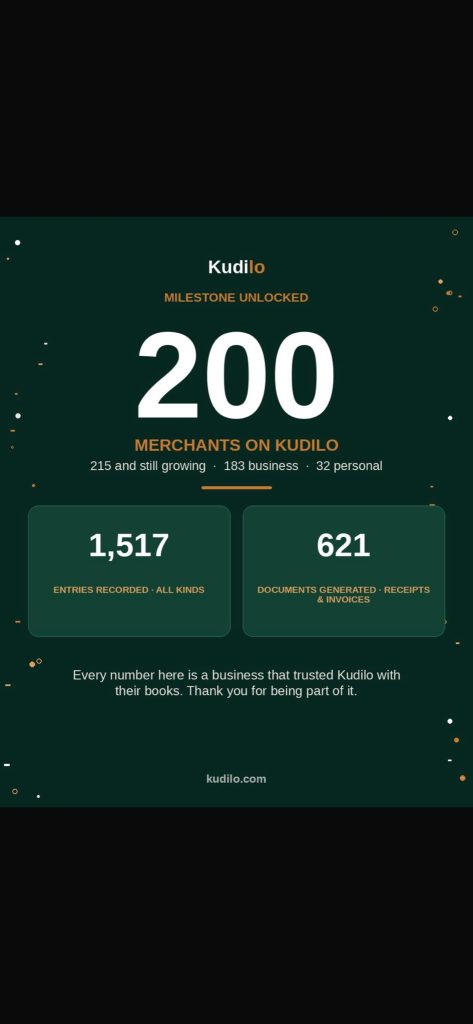
The testimonials (a food vendor, a fabric trader, a hair vendor and others) are positive and specific, but they are published by Kudilo and unattributed beyond first names and business types. The site offers no user numbers, no founder or team names, and no funding details that we could find.
Scope limits, stated by Kudilo itself.
Its bookkeeping guide says plainly that inventory valuation, payroll, statutory filings and multi-entity accounts may need a dedicated accounting system and an accountant. That candour is a point in its favour.
Techiesnode’s Verdict on Kudilo
Kudilo is a well-scoped answer to a genuine gap: getting small traders from memory and notebooks to records they can query, invoice from and hand to an accountant, at a price (₦3,000 a month) that a working business can justify. The Business Page and Personal Bills features stretch it beyond bookkeeping, and the flat pricing is a plus.
What it hasn’t yet shown is whether the chat-first promise survives real Nigerian speech, patchy networks and messy daily volume. That’s the infrastructure test, and it’s worth watching.
Techiesnode’s take: a credible, practical tool for micro and small businesses, with a few open questions that will decide whether it becomes everyday infrastructure.
Basis of this review: Kudilo’s public website, pricing, FAQ, product tour, security page and bookkeeping guide. Not independently hands-on tested.
Visit the Kudilo website to try it out.