Geeg.ng wants to address Nigeria’s advertising distribution problem by turning ordinary users’ feeds into ad inventory.
Nigeria’s advertising problem is partly a distribution problem. Brands, musicians and small businesses want attention on social platforms, but agency retainers and established influencers are priced beyond most of them. Social amplification marketplaces try to close that gap by turning ordinary users’ feeds into ad inventory. Geeg, which calls itself “Nigeria’s social amplification network,” is a useful case study of both the promise and the fragility of the model.
How the Geeg.ng model works
The mechanics are simple. Sponsors list a task: an ad, a song, a piece of content. Promoters, meaning everyday users with accounts on X, Instagram, TikTok or Facebook, share it with their followers and get paid. Geeg says payouts happen at month end, and it advertises verified accounts and reviewed campaigns. The sponsor buys reach, and the promoter sells access to a personal audience. The platform sits in the middle, matching the two sides and holding the money.
Why we think Geeg merits a #BuiltforAfrica Analysis
Three (3) conditions make the model plausible here. Firstly, Social media is where much Nigerian commercial and cultural attention already sits, especially for music and small-business promotion. Income pressure creates a large supply of people willing to do small paid digital tasks. And mass-market advertising is expensive, which leaves independent artists and small businesses wanting cheap reach. Naira payouts also spare promoters the friction of foreign payment platforms. The pitch is coherent.
Secondly, Cultural habit helps. Nigerian commerce has long run on recommendation, from word of mouth in markets to WhatsApp status adverts to the reshare culture of X and Instagram. A paid share from an ordinary account fits that habit more naturally than a polished campaign from a distant brand, because it arrives through someone the audience already knows.
Thirdly, the model is also mobile-first, so promoters need no studio, no production budget and no formal creator credentials, only a phone and a data plan. That lowers the barrier to entry for people outside Lagos-centric creator circles, including in cities like Ibadan, where the creator economy is real but rarely served by the big influencer agencies. The same low barrier cuts the other way, however. Data costs, uneven connectivity and the sheer volume of competing promotional content mean the value of any single paid share is probably small, and the model depends on volume to make the economics work.
What Geeg’s numbers suggest
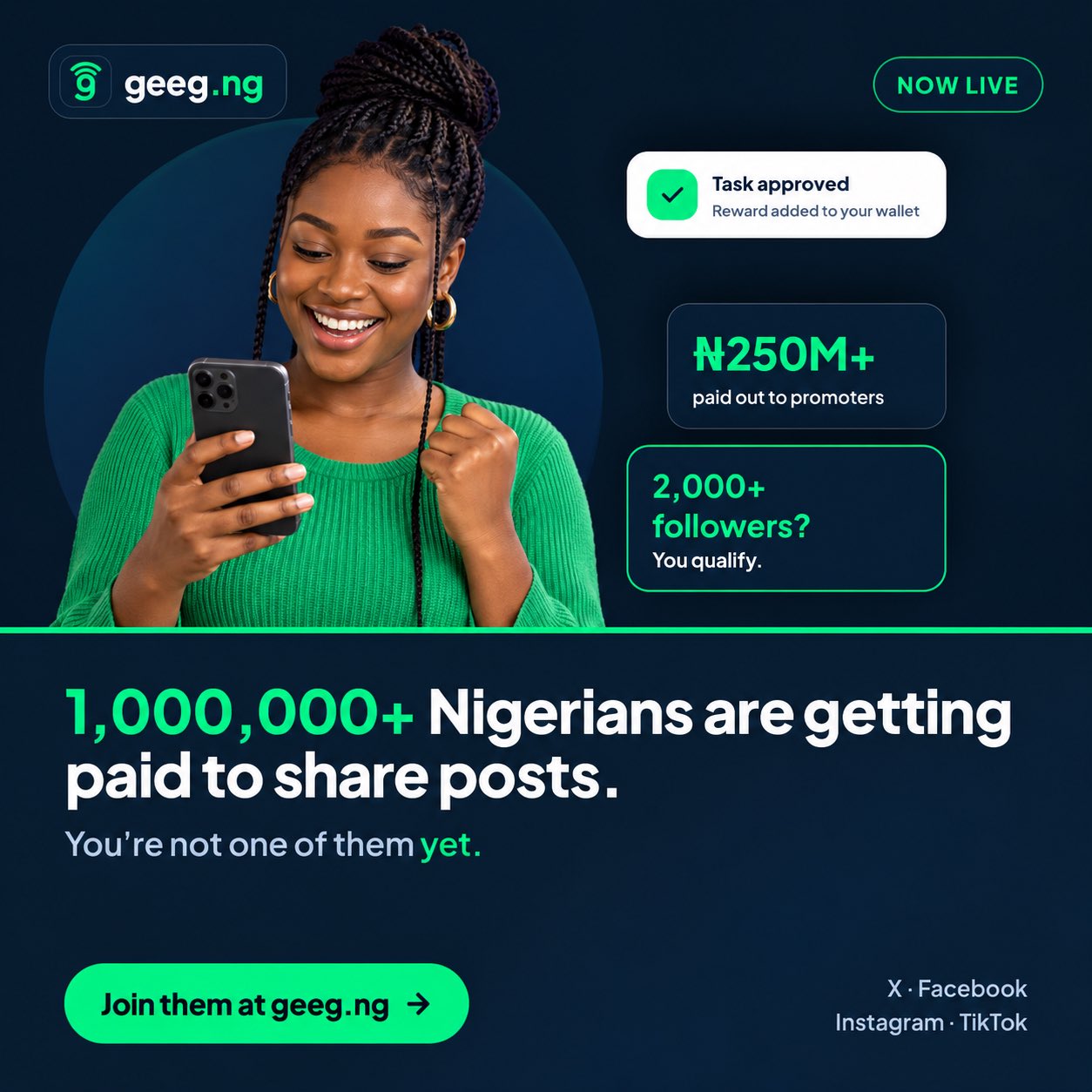
Geeg’s homepage claims 1M+ promoters, ₦250M+ paid out and 60+ live tasks. These figures are self-reported and unaudited, but even at face value they tell us something. ₦250M spread across a million promoters averages ₦250 each. Either payouts are concentrated in a small active group, or most registrations never earn. Sixty live tasks against a million promoters is roughly 16,000 promoters per task, so promoter supply far outstrips sponsor demand.
In a two-sided marketplace that imbalance matters, because growth is constrained by sponsor spend, not sign-ups. A million-promoter headline is good marketing but a weak indicator of market health. The same goes for “verified accounts,” “reviewed campaigns” and “month-end payouts.” They are claims to test, not proof.
The infrastructure problems
Verification.
The core product is reach, and reach is hard to verify. A sponsor can see that a post went up, but not easily whether real, relevant people saw it. Accounts that exist partly to earn per task invite low-quality engagement, including engagement pods and bots. Unless a platform can offer credible proof of delivery, sponsors will eventually find the reach they bought is thin, and spend will fall.
Platform dependence.
The model runs entirely on third-party platforms whose rules on spam, manipulation and undisclosed paid content can change without notice. The enforcement risk falls mostly on promoters, whose personal accounts are at stake. The platform’s own exposure is indirect.
Disclosure.
Paid posts that look like organic recommendations raise questions under advertising rules and consumer expectations. With music, paid sharing also blurs the line between real popularity and manufactured buzz. The model’s value depends partly on audiences not noticing that distinction, which is a fragile foundation.
Payment trust.
Month-end payouts help a platform manage cash flow, but they make promoters creditors of the platform for up to a month. Nigerians have watched many “earn online” schemes collapse, so payout reliability is the real credibility test. It shows up in the experience of small earners, not in cumulative totals.
What We are Hoping to See from Greg in the near future
A durable version of this category would publish active-promoter and median-earnings figures, give sponsors independently auditable delivery reports, label paid content clearly, and reduce its dependence on any single platform’s tolerance. These features are less exciting than a million-user headline, but they separate an ad network from a task-farming operation.
Our Verdict
Geeg points to real demand. Nigerian brands want affordable reach, and Nigerian users want small, regular income. But the evidence available so far shows scale in sign-ups, not proof of effectiveness. Until its verification, payout and disclosure practices are visible, Geeg is better read as a promising distribution experiment than as settled infrastructure.
Want to know more about the Geeg.ng platform? Visit the website here