Ebunoluwa Arimoro started her journey in tech as a software developer, helping to create solutions for other platforms, but somewhere along that journey, she realized that she could do more to fill the gap between Technology and the everyday realities of Nigerians than just write code. That resolution has led to her creating Jobapay, and founding a community of women in business and tech called the Herdacity Network.
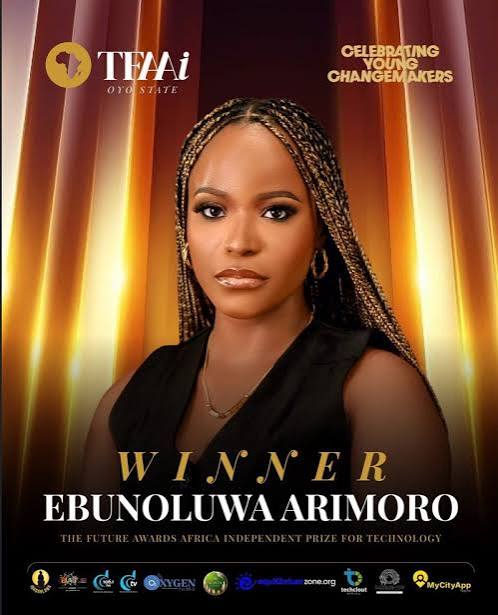
It has helped her win the 2026 The Future Awards Africa Independent (Oyo State) Award for Technology, and gained her visibility in ecosystem events such as Ibadan Tech Expo 2026 where she will be a speaker.
In this interview with our editor, Adebayo Adegbite, she talks about What awards and visibility in the tech ecosystem means to her, what founders and builders in the Oyo tech ecosystem should be looking at and many other interesting insights in her tech journey.
1. First of all congrats on your recent TFAAi Oyo award for Technology. It was a keenly contested category, so how does the winning make you feel?
It feels incredibly validating and humbling. Building products that bridge the gap between software and real-world operations takes a lot of focus. Winning this award just reinforces that the work we do in Oyo State is seen and is genuinely creating value in the ecosystem.
2. What drew you into building things in the first place? Was there a specific moment you knew you wanted to be a founder?
I have spent over seven years on the software side of creating solutions. Over time, you realize that writing code is only a small piece of the puzzle. A lot of that process involves watching how people do things, how they solve their current problems, and what adoption looks like over time. I got really fascinated with how technology got adopted in areas like financial payments in Nigeria, while other solutions just do not stick. The turning point for me was seeing the massive gap between what technology can do and the everyday realities of how people work. I realized I wanted to build comprehensive solutions that actually touch people’s lives and solve deep operational problems. So it was about moving from just observing and studying these things to actually being a part of the whole process, building a solution, and taking responsibility for how it performs from start to finish.
3. Oyo State/Ibadan isn’t the first place people think of when they think “Nigerian tech.” What’s it been like building your career and identity as a founder there rather than in Lagos?
It is quieter, cheaper, and slower in the places where slowness costs you. The cost is real and I will not romanticize it. In Lagos, you collide with people. You end up in a room and someone in that room happens to run a business or write checks. In Ibadan, you have to construct those collisions deliberately, and you spend money and hours on the road to be in rooms that other people walk into by accident.
But building in Ibadan also provides incredible clarity and the operational runway to test ideas deeply. I actively collaborate within the Lagos ecosystem through accelerator programs and community events. It is really about taking the focused environment of Oyo State and bridging it with the fast-paced network of Lagos.
4. What does this specific award, The Future Awards Africa Independent-Oyo State for tech represent to you?
To me, it represents the decentralization of innovation in Nigeria. It is proof that you can build solid, impactful platforms right here in Oyo State. It highlights that true impact is about the quality of your execution and the problems you solve, regardless of the state you are from.
5. Who or what do you credit for getting you here mentors, specific decisions, timing, luck?
It is entirely a collective effort. My sister and co-founder Alice is the operational backbone of everything we do. Beyond that, I credit the incredible community of builders around me. Watching men and women across Nigeria build amazing, innovative products right now is deeply motivating. Being in this space at a time like this, surrounded by people who are redefining what is possible in our ecosystem, is what pushes me to keep going and keep building.
6. You have been recognized as a voice in tech in Oyo State, first winning the TFAAi technology award, and now you will be speaking at Ibadan Tech Expo 2026 this November. Has winning changed how people treat you investors, peers, even family? Concretely, what’s different this month versus last month?
There is definitely a heightened level of visibility and incoming interest. People pay closer attention to what you are doing. However, my day-to-day reality remains very grounded. While recognition brings a lot of external talk about expansion, my daily focus this week is exactly what it was last month. I am focused on securing enterprise contracts for Jobapay and delivering flawless execution for the people who rely on us.
7. As someone who works in both the Lagos and Oyo tech ecosystems, and who now has the opportunity to share insights on the Oyo startup and tech ecosystem at a statewide tech event like Ibadan Tech Expo 2026, what do you think Oyo State’s tech scene needs more of right now, and do you see yourself playing a role in that?
I think we need three key things right now.
First, capital that does not require relocation. Right now, the honest advice to an ambitious founder in Ibadan is often to go to Lagos, and every time someone takes that advice, the city loses a little more of its own future. We need access to more capital flowing into the city itself, and more collaborations with the government and investors to intentionally bring funding here.
Second, first customers. Talent development is not our bottleneck anymore because we train people well. What we lack are local businesses willing to be somebody’s paying client, which is the only thing that turns a builder into a company.
Third, more founder hubs. Spaces where founders can meet, connect, share ideas, seek advice, and basically collaborate. We need rooms where opportunities are discussed freely and experienced founders are able to pour back into the ecosystem.
8. What’s a belief about building in Nigerian tech that you’ve had to unlearn or that turned out to be wrong?
I had to unlearn the idea that being technical is a moat. There is a misconception that being a technical founder puts you ahead of everybody else. In some cases, it does, but I have realized that technology is just a tool to solve the immediate problem your business needs to bring the final solution to your users. For instance, if WhatsApp is the technology your startup needs to manage users at that point in time, then that is what you need. More than being technical, it is the business aptitude, a deep understanding of your users, and your ability to provide the solution that truly matters. In Nigeria, it is not about using the most complex tech. Sometimes, simple does it better.
9. What’s the hardest year you’ve had building your career, and what got you through it? This past year has definitely been the most defining.
Pivoting Jobapay’s core strategy earlier this year from a consumer marketplace to a B2B workforce verification platform required stripping down everything we knew and rebuilding from scratch. It was a tough transition, but the unwavering support of my sister Alice, the Jobapay team, mentors, and the wider community of founders around me gave me the resilience to push through it.
10. Five years from now, what do you want Ebunoluwa to be known for?
I want to be known for making the invisible work of deskless workers visible. Right now, there are millions of people like security guards, cleaners, and technicians who show up and do hard work every single day, but they have no digital record to prove it. Because they cannot prove their work history, they often get cheated out of their pay, and banks will not give them loans. I want Jobapay to be the system that finally records and verifies their shifts. When their work is actually on the record, they get paid fairly and they can finally build the credibility to access credit. It is about giving everyday workers financial dignity.
Second, I want The HERdacity Network to be the ultimate destination for women in Nigerian tech. I want it to be a community where opportunities naturally flow in, rather than a place where women have to constantly chase them.
And finally, I want to still be writing openly about this entire journey. Sharing only the successful moments does not help the next generation of founders coming behind us.